
How to Engage Kids in a Bible Story with 4 Simple Steps
“How do we engage children in the Bible?” This age-old question remains important for almost every children’s ministry leader, parent, and pastor.
And if you’ve ever sat up late at night cutting out the gazillionth piece for a Pinterest craft that seemed like the perfect idea for kids, you may have found yourself thinking, “Is this really worth it?”
Today, we’re not only working with children’s endless energy. We’re also competing for their attention against electronic devices that offer hours of instant entertainment. It can feel as if every Bible lesson needs elaborate decorations, exciting games, and a picture-perfect craft just to keep kids interested.
Thankfully, there is an easier way to create engaging, Scripture-based lessons that don’t take hours upon hours of preparation. You can help a Bible story come alive with a few simple resources, such as a children’s worship bulletin and some crayons. These lessons can be meaningful without becoming complicated.
The goal isn’t to entertain kids every second. It’s to help them encounter God’s Word in a way they can understand, remember, and carry into everyday life. These four simple steps—storytelling, visualization, repetition, and sending something home—can help you do exactly that.
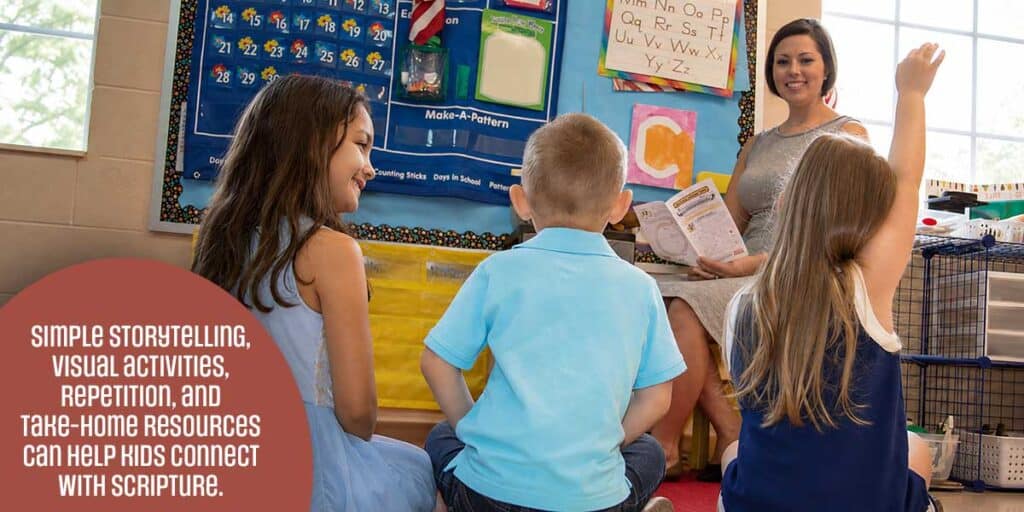
1. Be a storyteller
As Bible teachers, we want the stories of Scripture to come to life for our students. Effective storytelling, especially for young children, begins with finding the heart of the story.
To prepare, read the passage a few times, preferably directly from the Bible. The first time, simply read it for your own enjoyment and study. On the second reading, note the people, actions, repeated words, and turning points. Then ask yourself: What does this story reveal about God? What is the main lesson I want the children to remember?
Perhaps the story of Abraham shows faith and trust. Joseph can open a conversation about forgiveness and grace. David and Goliath can help kids talk about courage when something feels too big to face. Moses can show how God equips ordinary people for important work. Every passage contains many interesting things, but your teaching will be clearer when you choose one central meaning.
Once you know the main idea, focus on how you’re going to tell the story without reading every sentence from a page. Visualize the scene in your mind. What might the characters have seen or heard? Where could you pause? What voices, motions, simple props, or songs could you use to invite kids into the moment?
When children see your excitement, they are more likely to become curious themselves. Change your voice to distinguish one character from another. Whisper when the moment is quiet or uncertain. Slow down before an important choice. Use your face and hands to show surprise, sadness, joy, or love. These small changes can make a familiar Bible story feel fresh without adding hours of work.
For example, when telling the story of the battle of Jericho, add a little drama by tiptoeing and whispering as you describe the Israelites marching quietly around the city. When you reach the seventh day, cup your hands around your mouth to make a trumpet sound and use big, dramatic motions as the walls fall.
Afterward, tell the story again and invite the children to act it out with you. March quietly around the room as you recount the first six days. On the seventh day, let the kids make trumpet sounds and pretend the walls are falling around them. The action gives their bodies a role in remembering the lesson.
Don’t feel pressured to spend lots of time finding costumes and props unless you already have something useful nearby. A towel can become a shepherd’s head covering. A cardboard tube can become a scroll. A few chairs can become a boat. Kids have wonderful imaginations, and simple materials give them room to use them.
Being dramatic when you speak, changing your voice, and exaggerating your movements can go a long way toward making you an effective storyteller. Your enthusiasm is often more memorable than an expensive set.
2. Show the story visually
Crafts are fun, and sometimes they’re exactly the right choice. But crafts can also require a lot of preparation, leave little room for discussion, and make adults do more of the work than the kids. Some of the best ways to reinforce a Bible story are as simple as a coloring page, children’s worship bulletin, or activity sheet.
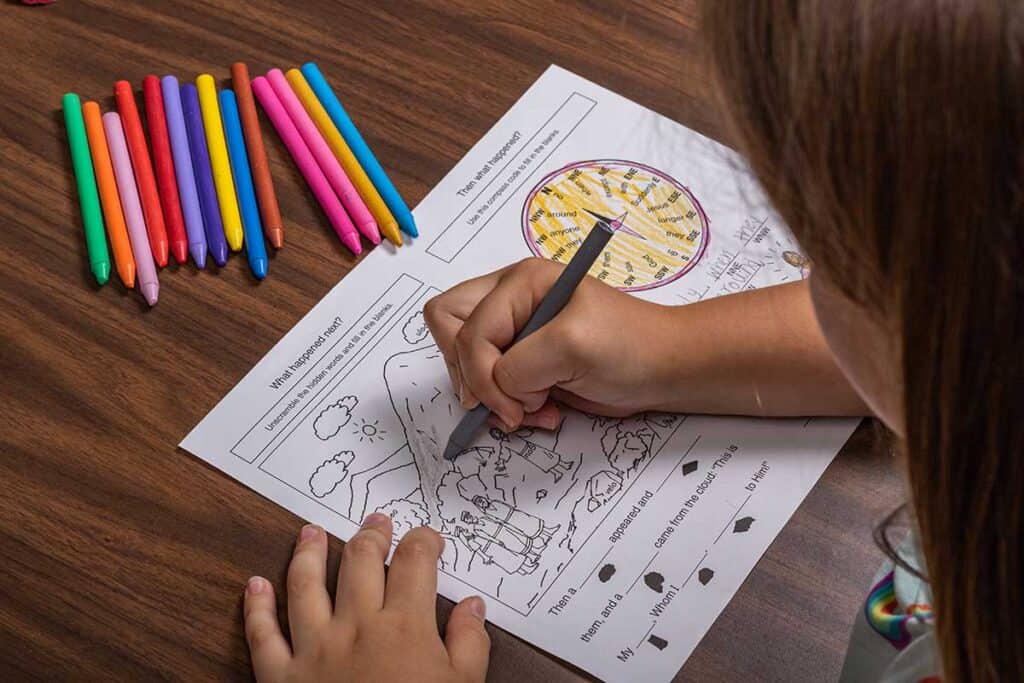
If you’re limited on time, a well-designed bulletin may be your most effective visual resource. Instead of treating it as something children complete quietly while the adults worship, connect it directly to your teaching.
Ask kids to search for details in the picture. Invite them to count people, circle an important object, trace a path, or color something as it appears in the story. This turns a page into an interactive Bible study tool and gives children a reason to look, listen, and respond.
For example, when teaching about baby Moses, ask, “What did Moses’ mother place him in?” When the children answer, “A basket,” invite them to find and color it. You could glue a few pieces of straw or grass to the paper to represent the reeds. From one sheet of paper, you’ve created a visual connection, a hands-on moment, and a simple review of the lesson.
The same idea works with many Scripture passages. Kids can draw stones beside David before he faces Goliath, add stars to a page about God’s promise to Abraham, or draw a colorful coat while learning about Joseph. A verse printed on the page can become a memory challenge, a prayer prompt, or the beginning of a family discussion.
Another way to show the story visually is to use play dough. This is especially helpful when the people in the passage build something, travel somewhere, or encounter a memorable object. Children might create Noah’s ark, Solomon’s temple, food from a story Jesus told, or the landscape where an important event took place.
Once you’ve shared the Bible story, separate the children into groups of two or three and ask them to make something connected to it. For older kids, set a timer and give them five minutes, or longer if your schedule allows. Then let each child or group use their creations to retell part of the story.
As they share, ask open-ended questions: “Why did you include that?” “What happened next?” “How do you think this person felt?” Their answers reveal what they understand and create a natural conversation. You can gently clarify details while encouraging their effort and wisdom.
So, save yourself the headache. Put down the scissors when the complicated project isn’t serving the goal, and choose reliable resources you can use in more than one way. A good children’s worship bulletin can support listening, coloring, discussion, prayer, and review—all without turning Saturday night into a crafting marathon.
3. Repeat—and keep repeating
Have you ever noticed that when the Bible repeats an idea, it is often inviting us to pay attention? The same principle applies when teaching children. Repetition is one of the most effective tools for helping kids understand and remember.
Choose a short phrase, question, or motion that captures the point of the lesson. Introduce it near the beginning, bring it back during the story, and repeat it again at the end.
For example, if the lesson is about kindness, you might ask, “How can we show God’s love?” The kids could respond, “With our words and our actions!” If you are teaching about grace, try, “Does God stop loving us when we make a mistake?” and let them answer, “No! God helps us begin again.”
You may not get much response the first time. That’s okay. The more you repeat the words, the more confidently kids will join in. Soon they’ll be excited because they know the answer and can finish your sentence.
Repetition should not feel like a test. Keep it warm, playful, and encouraging. Add a hand motion, clap a rhythm, or invite one side of the room to ask the question while the other side answers. This gives every child a low-pressure way to participate.
You can also repeat one short Scripture verse throughout the class. Say it together when kids arrive, after the story, and before they leave. Connect the verse to a real-life situation: sharing with a sibling, welcoming a new student, telling the truth, or showing kindness to someone who feels left out. This helps children understand that faith is more than knowing the right answer; it shapes the way followers of Christ live.
Repetition also means creating a routine children can count on from week to week. A predictable environment offers security and supports learning. Your routine might include a welcome activity, a Bible story, a few discussion questions, a children’s worship bulletin, prayer, and a simple take-home challenge.
The content changes each week, but the familiar pattern helps kids know what to expect. Instead of spending their energy figuring out what comes next, they can focus on the lesson itself.
4. Send something home
One of the best ways to help children remember what they learned at church is to give their family an easy way to continue the conversation at home. A take-home page helps parents and caregivers reinforce the story in the days ahead—even if they weren’t in the room when you taught it.
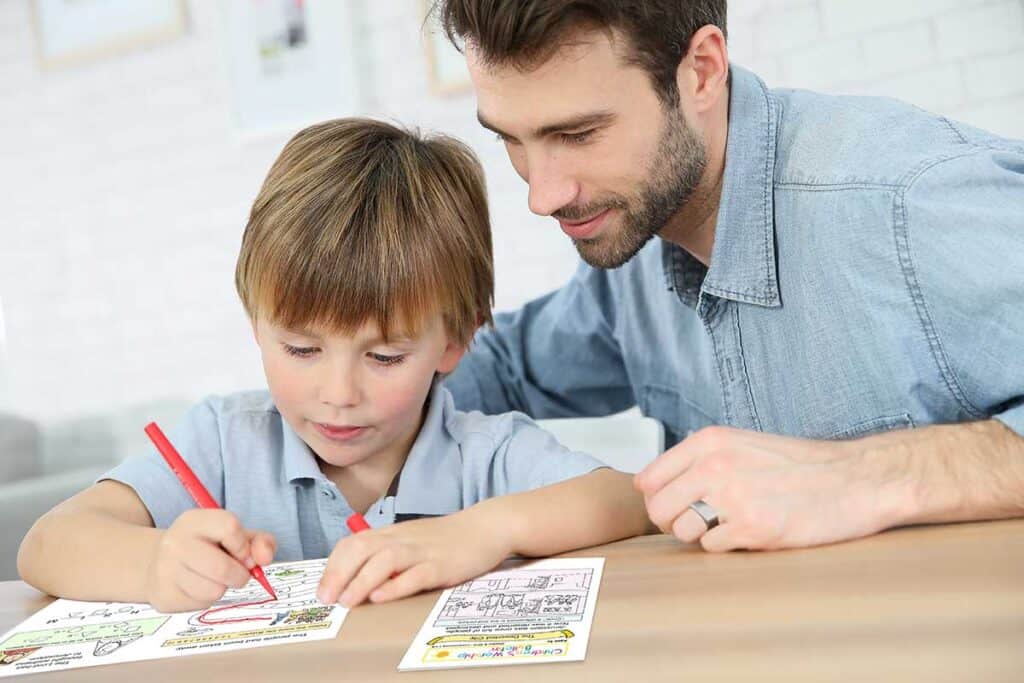
Children’s worship bulletins are especially helpful because kids already have something they drew, colored, or completed themselves. That sense of ownership makes them more likely to show the page to someone else.
If you can customize the front or back, add a section called “What We Learned Today.” Include the Bible reference, one-sentence lesson, key verse, and two simple questions. You could also add one action the family can try together.
For example:
- Our story: David and Goliath
- Our lesson: We can trust God when we feel afraid.
- Talk about it: What is something that feels difficult to you right now?
- Try it: Pray together and name one brave, faithful step you can take this week.
These prompts turn a bulletin into more than a Sunday activity. They help parents lead a short, natural Bible study without needing special training or additional supplies. A conversation might happen in the car, at dinner, or before bed.
Encourage kids to be the teachers. Ask them to use the pictures to retell the story to their family. They can explain the puzzle, demonstrate the repeated motion, or teach everyone the key phrase. Children love sharing what they know, and retelling strengthens both understanding and confidence.
You can also suggest one simple practice connected to the theme. After a lesson about kindness, a family might choose someone to encourage. After a story about generosity, they could give away a toy or donate food. After learning about love, they might write a note to someone who is lonely. These practices connect Christian teaching to real life and help faith move from the page into the week.
Keep it simple and keep the focus on Scripture
Engaging kids in worship shouldn’t completely consume your time. You don’t need a storage room full of supplies or a new craft for every lesson. You need a clear story, a central truth, a few thoughtful questions, and a way for children to participate.
Tell the Bible story with energy. Give children something visual to explore. Repeat the most important idea. Then send home a resource that invites the family to keep learning together.
Author Bio:
Kristen Greene
Kristen Greene is the Creative Director of Communication Resources, Inc. Being the daughter of a Publisher and active Church Leader, she grew up in the Church Publishing Industry. She has also been involved in multiple church roles and non-profit events – which makes solving real church and volunteer problems near and dear to her heart. Kristen enjoys camping with her husband and two small children, painting, and gardening.